
Reputation Management & Brand Visibility: The Growth Multipliers Companies Often Overlook
Growth Isn’t Just About Getting Seen Anymore
For years, business growth conversations centered around familiar levers: more advertising, more leads, more outreach, more markets.
Those still matter.
But companies that scale sustainably often share something less obvious and significantly harder to replicate: they become trusted before they become dominant.
Today’s customer rarely makes decisions in a straight line.
Before contacting a business, they search your company name, read reviews, compare alternatives, browse social media, visit your website, and look for signals that answer one question:
Can I trust this company?
That shift has changed how businesses grow.
Brand visibility creates opportunities to be discovered. Reputation management determines whether those opportunities become revenue.
Companies that understand both tend to scale more efficiently, convert more consistently, and retain customers longer.
Why Trust Has Become One of the Most Valuable Business Assets
Modern buyers complete much of their decision-making process before they ever speak with a company.
Research across consumer behavior continues to point in the same direction:
Studies from BrightLocal consistently show that online reviews influence purchasing decisions across industries.
The Edelman Trust Barometer repeatedly demonstrates that trust plays a measurable role in customer loyalty and buying behavior.
Google’s Zero Moment of Truth framework highlights how search and digital research shape purchasing decisions before direct engagement occurs.
This matters because trust reduces uncertainty.
When uncertainty decreases:
Conversion rates often improve
Sales cycles become shorter
Customer acquisition becomes more efficient
Referrals increase
Customer retention strengthens
Businesses gain greater pricing flexibility
Trust creates momentum.
Customers buy faster when confidence already exists.
That’s why reputation management has evolved from a customer service function into a strategic growth initiative.
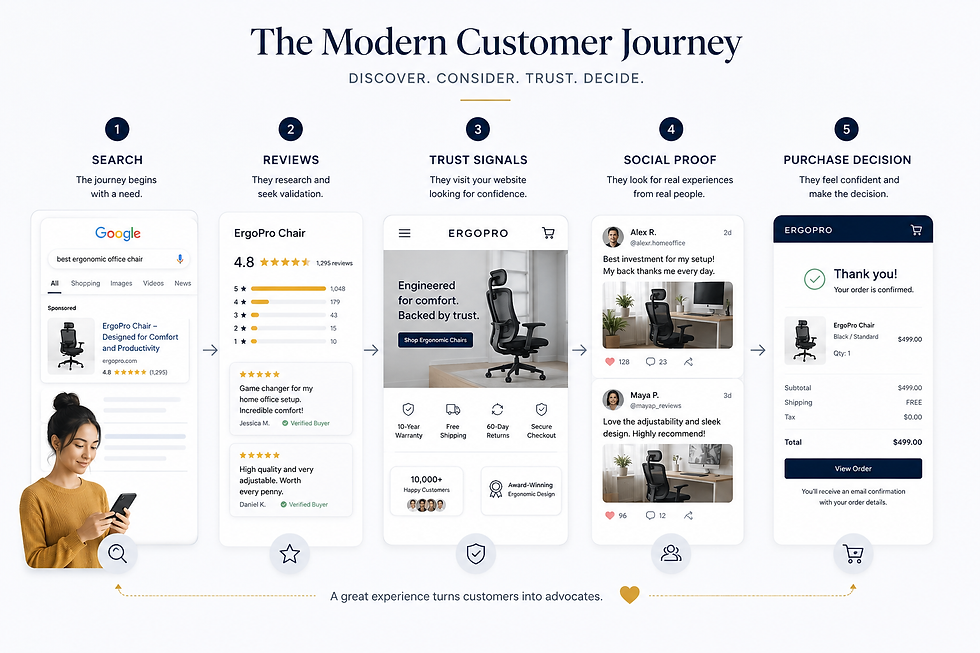
Reputation Is Built Long Before Someone Becomes a Customer
When businesses hear “reputation management,” many think of responding to negative reviews.
That’s only one piece.
Reputation management is the process of intentionally shaping how customers experience, perceive, and talk about your company across every stage of the buying journey.
Strong reputation systems usually include:
Consistent Review Generation
Creating ongoing opportunities for customers to leave authentic feedback.
Active Review Engagement
Responding professionally and reinforcing customer confidence publicly.
Brand Consistency
Aligning messaging, visuals, customer experience, and expectations.
Search Presence
Understanding what customers see when they search your business.
Social Proof Development
Building trust through testimonials, case studies, and community visibility.
Experience Optimization
Creating experiences that customers naturally want to share.
Businesses that approach reputation proactively tend to create stronger foundations for growth than those reacting after problems appear.
Visibility Without Credibility Rarely Creates Sustainable Growth
There are exceptional companies that remain small simply because they are difficult to discover.
There are also highly visible companies that struggle because visibility alone does not create confidence.
Brand visibility means more than followers or impressions.
It means showing up consistently in the places where decisions happen:
Google Search
Google Business Profile
Review platforms
Social media
Video platforms
Industry publications
Local search
Educational content
Most customers interact with multiple touchpoints before reaching out.
Each interaction either builds confidence—or introduces friction.
Low visibility often creates challenges such as:
Higher customer acquisition costs
Longer decision timelines
Reduced referral opportunities
Greater dependence on paid advertising
Increased customer skepticism
This is where strategy matters.
Many growing businesses discover that improving trust signals and visibility together produces stronger results than increasing marketing spend alone.

The Business Metrics Most Influenced by Brand Trust
Trust can feel intangible.
Operationally, it shows up everywhere.
Businesses with stronger trust indicators often see measurable differences in performance.
Business Metric | Impact of Strong Trust |
Website Conversion | Higher |
Lead Quality | Improved |
Sales Cycle | Shorter |
Customer Acquisition Efficiency | Increased |
Repeat Business | Higher |
Referral Volume | Increased |
Customer Retention | Stronger |
These improvements rarely happen overnight.
They compound.
Recognition becomes familiarity.
Familiarity becomes trust.
Trust becomes growth.
That cycle is difficult for competitors to copy once established.
Building Trust Is Less About Promotion, And More About Consistency
One of the biggest misconceptions in marketing is that trust comes from saying the right things.
Customers are becoming increasingly effective at filtering promotional language.
Trust is usually built through repeated proof.
Businesses that strengthen brand trust often focus on:
Showing Results Instead of Claims
Publishing outcomes, case studies, and real examples.
Creating Useful Content
Helping customers understand challenges before they buy.
Strengthening Customer Experience
Making interactions easier, faster, and more reliable.
Building Search Confidence
Ensuring customers find current, credible, and consistent information.
Educational visibility often outperforms promotional visibility because it creates authority before purchase intent exists.
That’s one reason content has become such an important growth channel.

The Best Time to Manage Reputation Is Before You Need To
Most companies begin investing in reputation only after growth slows or negative feedback appears.
The strongest brands treat reputation as infrastructure.
That means creating systems before they become necessary.
Examples include:
Customer feedback loops
Review collection processes
Search monitoring
Brand consistency standards
Crisis communication preparation
Content authority initiatives
Strong reputation does not prevent challenges.
It creates resilience when they happen.
And resilience becomes increasingly valuable as businesses scale.
Visibility Creates Attention. Reputation Creates Momentum.
Marketing creates awareness.
Reputation turns awareness into confidence.
Confidence drives action.
When those functions operate independently, growth becomes inefficient.
A company can generate substantial traffic and still struggle to convert if customers encounter inconsistent messaging, weak reviews, or limited authority signals.
Businesses increasingly look beyond isolated campaigns and instead focus on building connected systems across:
Brand visibility
Customer experience
Reputation management
Search presence
Content strategy
That alignment often determines whether growth becomes sustainable.

The Brands That Scale Consistently Usually Earn Confidence First
Growing a business today is rarely about being the loudest.
It’s about becoming the easiest company to trust.
The strongest brands create environments where customers arrive already confident in their decision.
Visibility creates recognition.
Reputation creates confidence.
Trust creates momentum.
And together, they create the conditions for sustainable growth.
Where Growth Opportunities Often Hide
If your company is investing in marketing but growth feels harder than expected, more spend may not be the answer.
Sometimes the biggest opportunities exist in how customers discover, evaluate, and trust your business.
At Grandeur Marketing Group, we help businesses identify visibility gaps, strengthen reputation signals, and create systems designed to support long term growth. Not just short term attention.
Because growth becomes easier when trust is built into the foundation.

Comments